16 min read · Fractional Chief AI Officer · AI Leadership
What Is a Fractional Chief AI Officer?
Capio team

What a fractional Chief AI Officer does, what it costs, how it differs from a consultant or CTO, when you need one and what success looks like in the first months.
A fractional Chief AI Officer (CAIO) is a senior AI leader who does the job of a Chief AI Officer part time, for several organisations at once. They own the AI agenda: what gets built, in what order, under what rules and how it's measured. They're accountable for results, but you don't pay a full-time executive salary.
The role exists because most organisations have reached an awkward point with AI. Staff are using tools, a few pilots are running and the board is asking questions. But nobody senior owns it. A full-time AI executive is expensive, hard to find and often premature. A fractional CAIO fills that gap until the organisation either grows into a full-time hire or can run AI itself.
This guide covers what the role actually involves week to week, what it costs, how it compares with the alternatives, when you need one (and when you don't) and how to tell whether it's working.
A Chief AI Officer makes sure AI creates business value without creating risks the organisation can't handle. In practice that breaks down into five responsibilities:
- Direction. Owning the AI roadmap. Deciding which problems AI should solve, in what order, and getting the leadership team to agree.
- Governance. Setting the rules: which tools are approved, what data can be used where, how risk is assessed, where humans stay in the loop and who signs off.
- Portfolio. Tracking every AI initiative against a business outcome, an owner and a success metric. Stopping the ones that aren't earning their place.
- Capability. Building AI fluency across leadership and teams, so the organisation understands what it's doing and doesn't depend on outsiders forever.
- Accountability. Being the one person the board can hold responsible for AI results and AI risk.
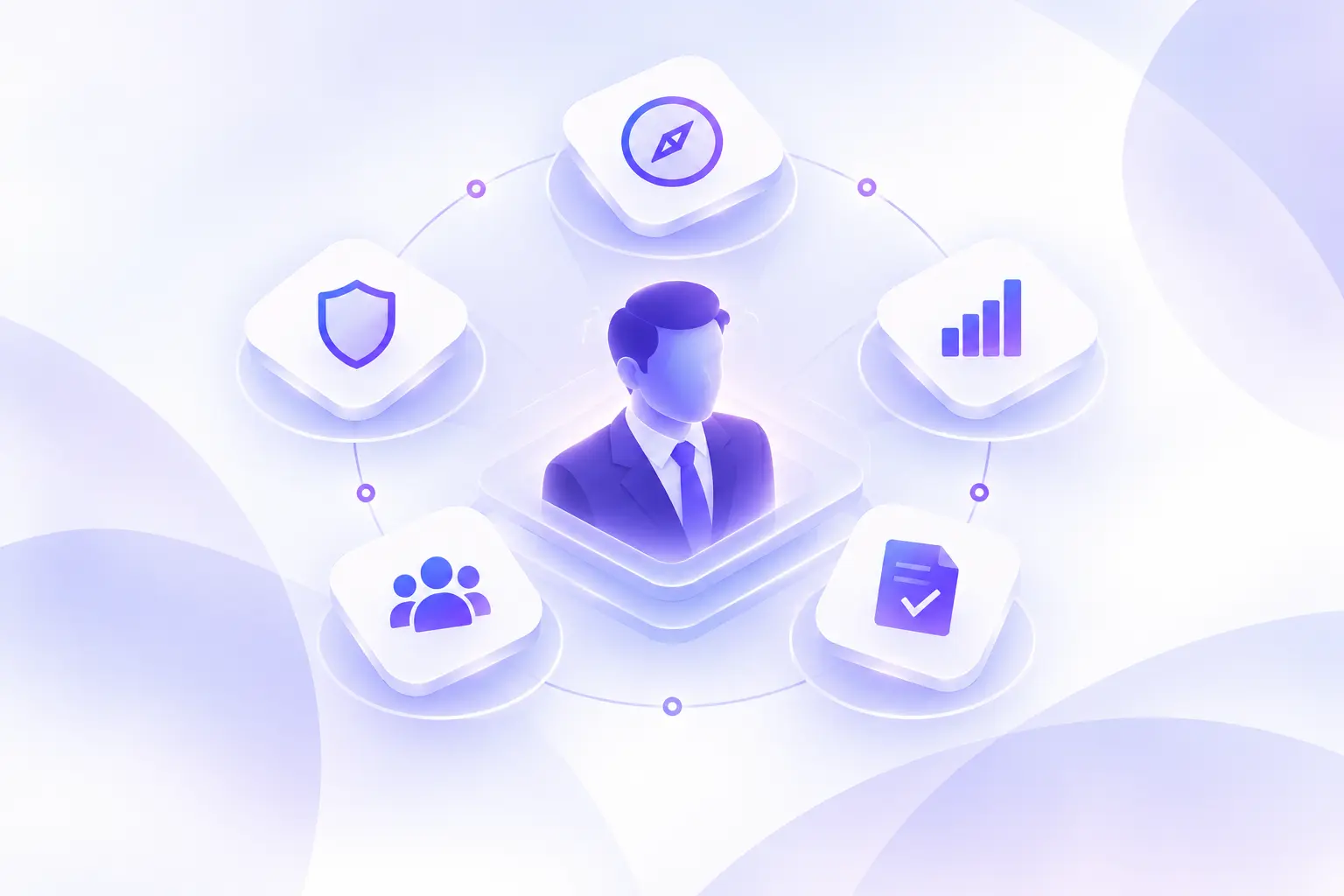 Five pillars: direction, governance, portfolio, capability, accountability
What a CAIO usually does not do is run engineering or own the technology platform. That's the job of a CTO or IT lead. The CAIO decides what AI should achieve and makes sure it does. The technology team decides how it's built and run.
The role has moved from unusual to mainstream very quickly. In an <a href="https://www.fairfaxtimes.com/online_features/press_releases/ibm-study-ceos-are-reshaping-c-suite-roles-for-the-ai-era/article_580aa4a1-2190-5551-967c-a9a40261919e.html" target="_blank" rel="nofollow noopener noreferrer">IBM Institute for Business Value study of 2,000 CEOs</a> across 33 countries, carried out with Oxford Economics in early 2026, 76% of organisations surveyed said they had a Chief AI Officer, up from 26% a year earlier. Those are mostly large organisations. Smaller and mid-sized firms face the same questions with a fraction of the budget, which is where the fractional model comes in.
What makes a Chief AI Officer "fractional"?
Fractional means you get a share of a senior person's time on a regular, ongoing basis, instead of all of it. They hold the role, sit with the leadership team and own the outcomes, but they work a set number of days or hours a month and usually serve more than one organisation.
That makes it different from three things people often confuse it with:
- A consultant advises on a project, delivers a report or a build and leaves. A fractional CAIO holds the role and stays accountable over months.
- An interim executive fills a full-time seat for a fixed period, usually while a permanent hire is found.
- An AI agency builds what you ask for. A fractional CAIO decides what should be built in the first place, and may manage agencies on your behalf.
Published fractional CAIO offers in October 2026 described time commitments anywhere from about 15 to 35 hours a month, or one to three days a week in heavier phases. It's usually more at the start, when the roadmap and governance are being set up, and less once things are running.
Fractional CAIO, full-time CAIO, consultant or agency: which do you need?
They solve different problems. The quickest way to choose is to look at what's actually missing.
| Option | Best when | What you get | Watch for |
|---|---|---|---|
| Fractional CAIO | Nobody senior owns AI, and a full-time hire is premature or unaffordable | Ongoing senior ownership of strategy, governance, portfolio and results | Needs a sponsor with authority and someone internal to work alongside |
| Full-time CAIO | AI is central to the business, with a large portfolio and budget | A dedicated executive, always available | High cost, long recruitment, hard to judge candidates if nobody inside understands AI yet |
| AI consultant or advisory firm | You need a specific piece of work: an assessment, a strategy, a policy | Expertise for a defined scope | Leaves when the project ends; ownership stays unsolved |
| AI development agency | You already know exactly what you want built | Delivery capacity | Builds what you ask for, not necessarily what you need |
| Fractional CTO | Your problem is the technology platform itself | Ownership of architecture and engineering | Not focused on AI value, adoption or AI governance |
| Upskilling an internal leader | You have a strong internal candidate with time and backing | A permanent owner who knows the business | Takes time; they need support while they learn |
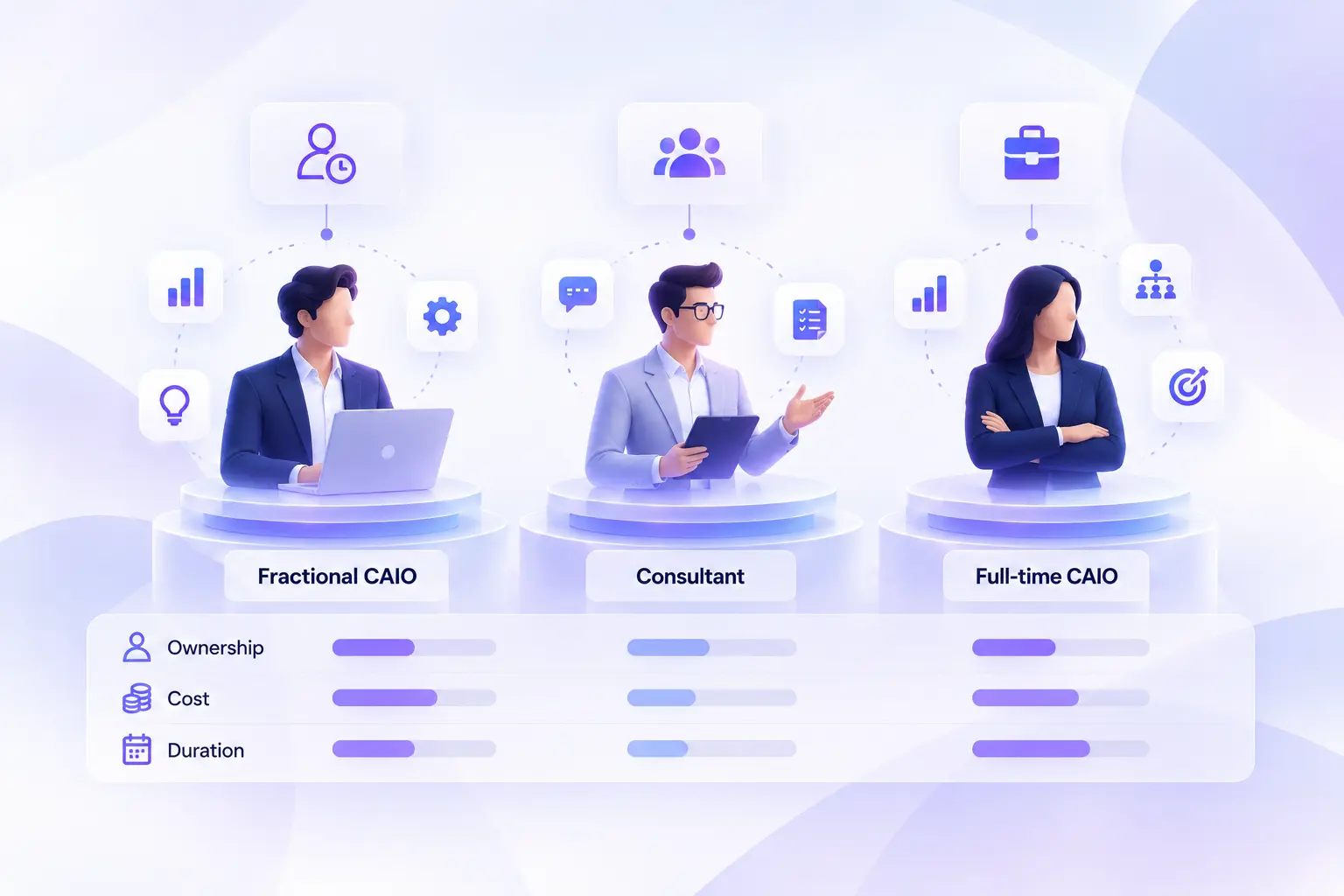 Comparison of fractional CAIO, full-time CAIO, AI consultant and AI agency by ownership, cost and duration
These aren't mutually exclusive. A common and sensible pattern is a fractional CAIO who owns the agenda, an agency or internal team that builds, and an internal leader who is gradually trained to take the role over.
When does a business need a fractional Chief AI Officer?
When AI activity is happening but nobody senior is accountable for where it's going. The signs are usually obvious once you look for them:
- Different teams use different AI tools, with no shared rules on what data goes into them.
- Pilots have run, but nobody can say clearly whether they worked or why they stalled.
- The leadership team discusses AI regularly but doesn't decide anything.
- The board or investors ask about AI strategy and get a different answer from each executive.
- A significant AI spend is planned and nobody owns the business case.
- Regulatory or data protection exposure from AI use has no clear owner.
- Competitors are visibly moving faster.
If three or more of those sound familiar, the gap is leadership, not technology.
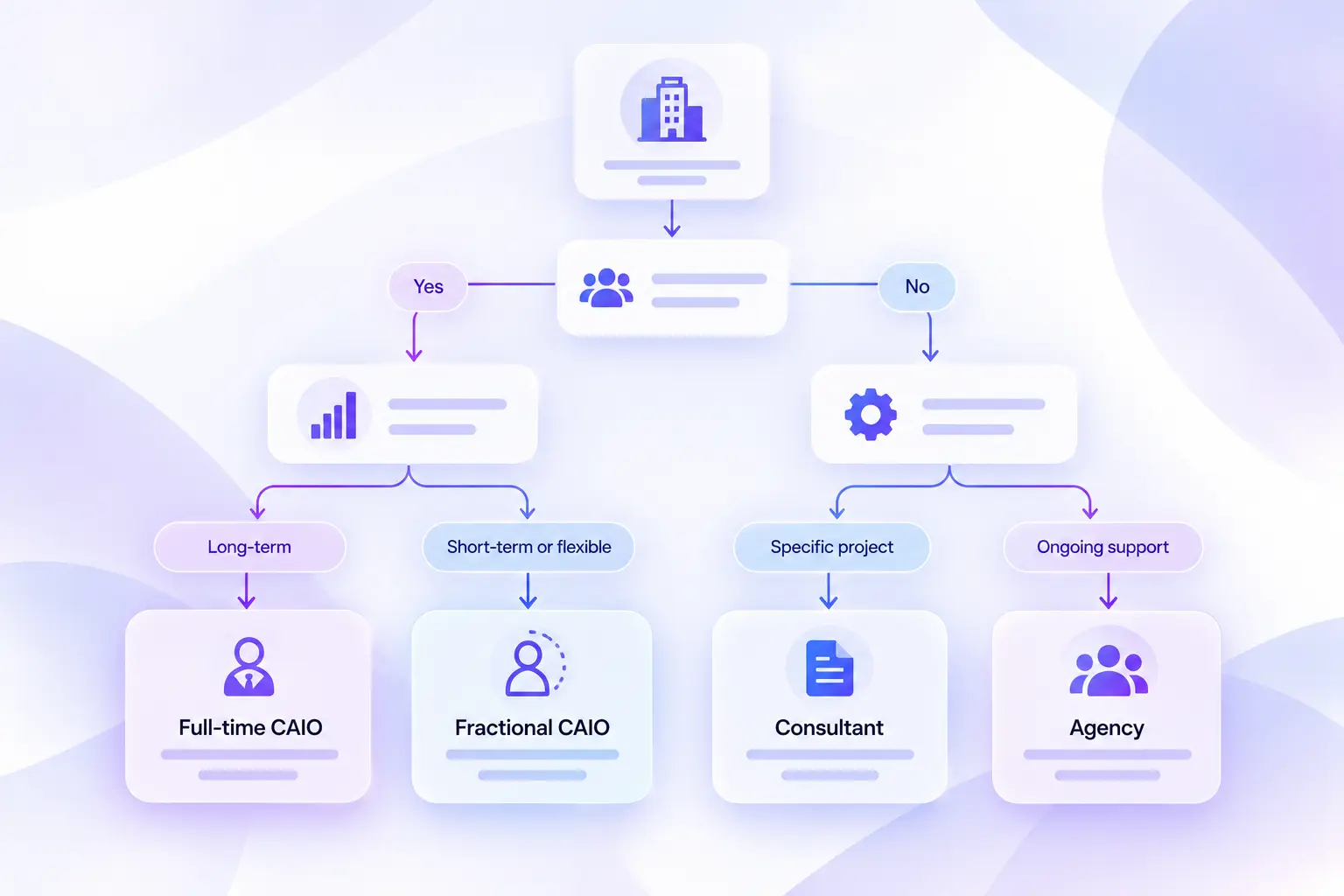 Decision flowchart showing when to hire a fractional Chief AI Officer, a full-time CAIO, a consultant or an agency
When is a fractional CAIO the wrong choice?
It's worth saying plainly, because most pages on this topic are written by people selling the service.
- You don't have a senior sponsor. A fractional CAIO without backing from the CEO or MD becomes an adviser nobody listens to.
- What you need is build capacity. If strategy and ownership are already clear and you just need things built, hire engineers or an agency.
- AI is your core product. If you're an AI company, you probably need full-time AI leadership inside the business.
- The data foundations are missing entirely. If core data is scattered, inaccessible or untrusted, some data work has to happen first. A good CAIO will tell you this, but you may need a data project before a full AI programme.
- You want someone to "do AI" for you. The role builds ownership inside your organisation. If nobody internal will take part, the value leaves when the CAIO does.
What does a fractional CAIO actually do day to day?
Most of the work happens in a steady monthly rhythm built around decisions, not activity. A typical month looks something like this:
- AI steering committee. A short monthly meeting of four to six senior people with real authority. The CAIO chairs or co-runs it. Decisions on priorities, funding, approvals and stopping pilots are made and recorded here.
- Portfolio review. Every initiative checked against its metric and owner. What's working gets more support. What isn't gets fixed or stopped.
- Governance work. Approving new tools and use cases, updating policies as rules change, handling risk questions and documentation.
- Working sessions with owners. Helping business owners scope use cases, unblock data access, manage vendors and plan adoption.
- Capability building. Sessions with leadership and teams based on their own live projects, not generic AI training.
- Board reporting. A clear view of progress, value and risk in business language.
 Monthly rhythm of a fractional Chief AI Officer: steering committee, portfolio review, governance, working sessions, training and board reporting
The CAIO is not the person writing code or configuring tools. They make sure the right things get built, the right rules are followed and the results are measured.
What happens in the first three months?
The first three months set up everything else, so they're worth understanding before you hire anyone. A well-run engagement usually follows a pattern like this.
Month one: baseline. Interviews with leadership and the people who do the work. An inventory of every AI tool and initiative in use, official or not. An honest assessment of data, systems, skills and governance. Agreement on the few problems worth solving first. Many engagements start with a structured AI readiness assessment for exactly this reason.
Month two: governance. The steering committee is formed and meets for the first time. Responsible AI guardrails and approval routes are written, covering local regulation and data rules. Every initiative gets a named owner and a single success metric.
Month three: first decisions. Use cases are scored on value and feasibility. The strongest one or two move into a pilot with a clear gate. The board gets its first real view of progress.
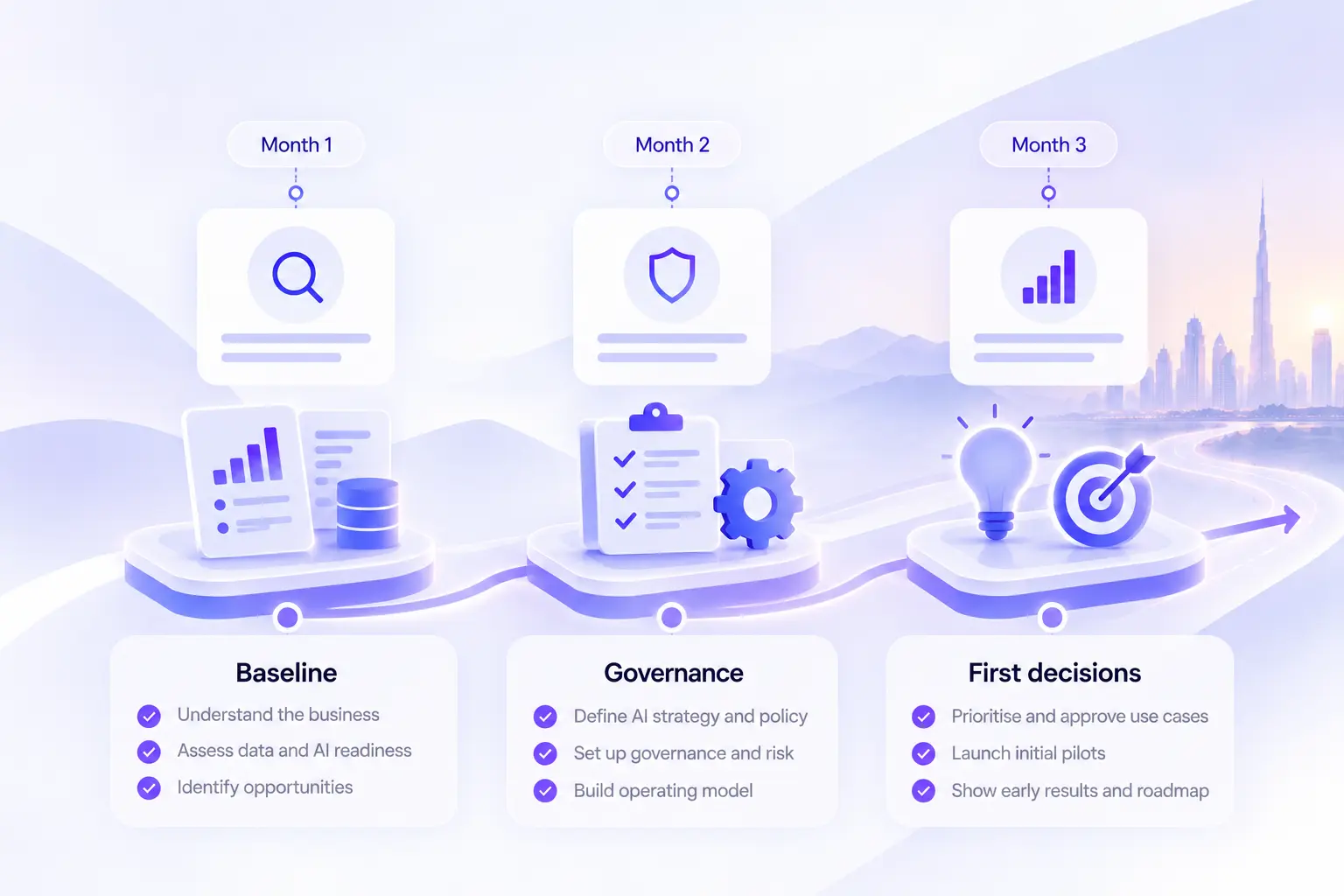 Timeline of a fractional CAIO's first three months: baseline, governance and first decisions
By the end of month three you should have a prioritised roadmap, working governance, a short list of measured initiatives and a leadership team that agrees on direction. If you don't, something is wrong.
How much does a fractional Chief AI Officer cost?
Usually a monthly retainer set by time commitment and scope. Published rates we found in October 2026 ranged from about AED 10,000 to AED 20,000 a month for UAE offers, and roughly $8,000 to $22,000 a month in the US, with UK offers around £7,000 to £16,000 a month. Some providers also sell a standalone assessment first as a fixed fee.
Treat those as a guide, not a benchmark. What you pay depends on:
- Time commitment. Hours or days a month, and whether it's heavier at the start.
- Scope. How many business units, initiatives and teams the role covers.
- Governance needs. Regulated sectors and strict data rules take more work.
- Seniority and experience. Someone who has led AI in your sector costs more and usually needs less time to get results.
- What's included. Some retainers include training, assessments or delivery support. Others are leadership only.
The comparison that matters is against the alternatives. A full-time C-level executive costs a full senior salary, benefits and months of recruitment. An advisory firm charges project fees and leaves when the project ends. A fractional CAIO sits in between: senior ownership on a monthly basis, with the option to scale up or down.
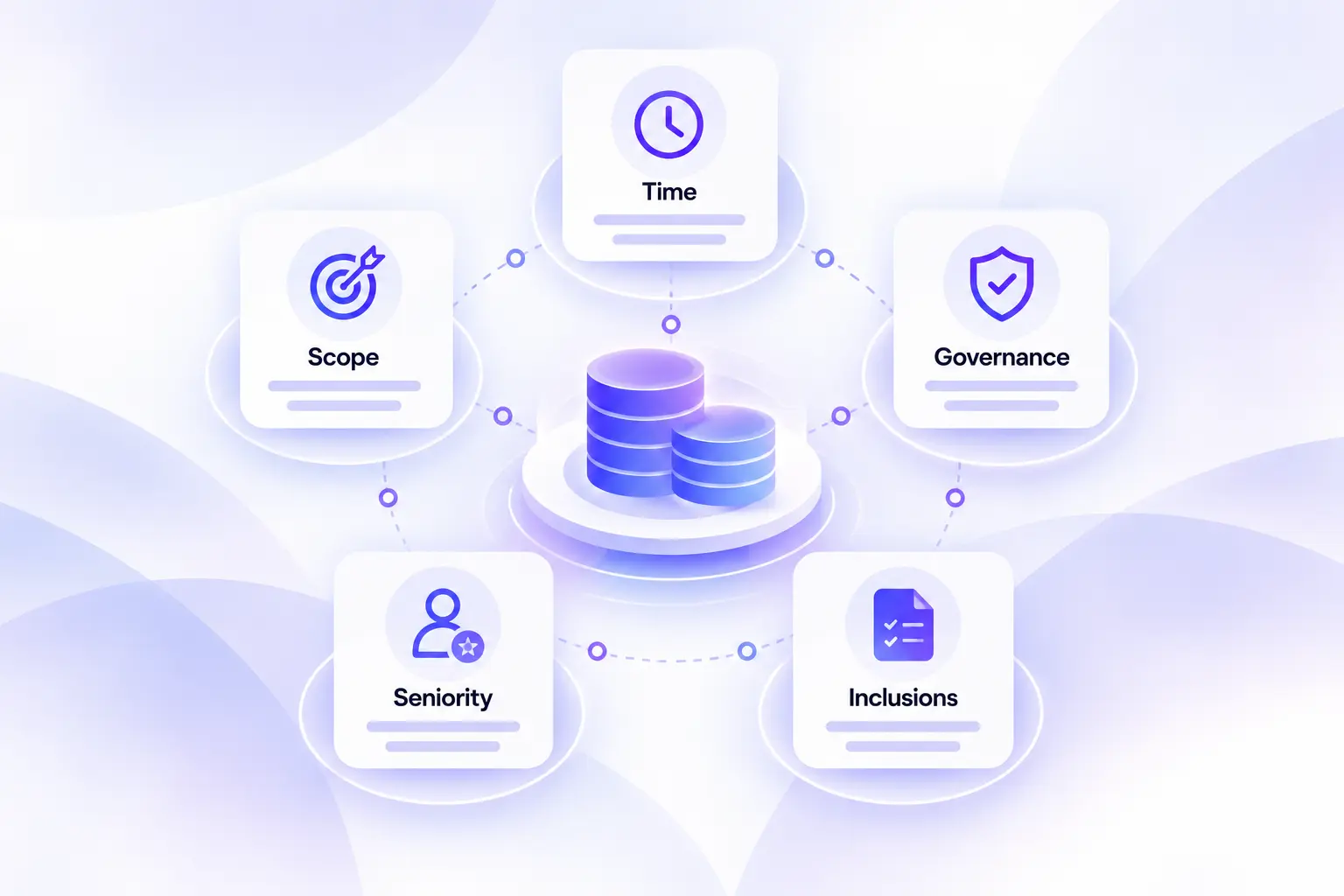 What drives the cost of a fractional Chief AI Officer: time, scope, governance needs, seniority and inclusions
Watch out for very cheap offers. A few hours of advice a month labelled "fractional CAIO" is a consultant on a retainer, not someone who owns your AI agenda.
What should a fractional CAIO deliver?
By the time the engagement ends, the organisation should own a set of tangible things, not just memories of good meetings:
- An AI strategy and roadmap, with every initiative linked to a business goal
- A working governance framework: committee charter, policies, approval routes and human-in-the-loop rules
- Compliance documentation suited to your sector and location
- A portfolio of initiatives, each with an owner, a baseline and a measured result
- A board-level view of AI progress, value and risk
- Trained leaders and teams who can run the function day to day
- A plan for who owns AI after the fractional CAIO steps back
If a provider can't tell you upfront what you'll own at the end, ask until they can.
How do you measure whether a fractional CAIO is working?
Look for decisions and numbers, not activity. Signs it's working, roughly in the order they should appear:
- Within the first month: the leadership team agrees on priorities, often for the first time.
- Within two months: a steering committee meets and makes recorded decisions; every initiative has an owner and a metric.
- Within three months: the first pilot is running against a baseline with a clear decision date.
- Within six months: at least one initiative has moved a business metric; at least one weak initiative has been stopped on evidence; governance questions get answered in days, not months.
- Over time: your own people present AI progress to the board, and the organisation needs the fractional CAIO less, not more.
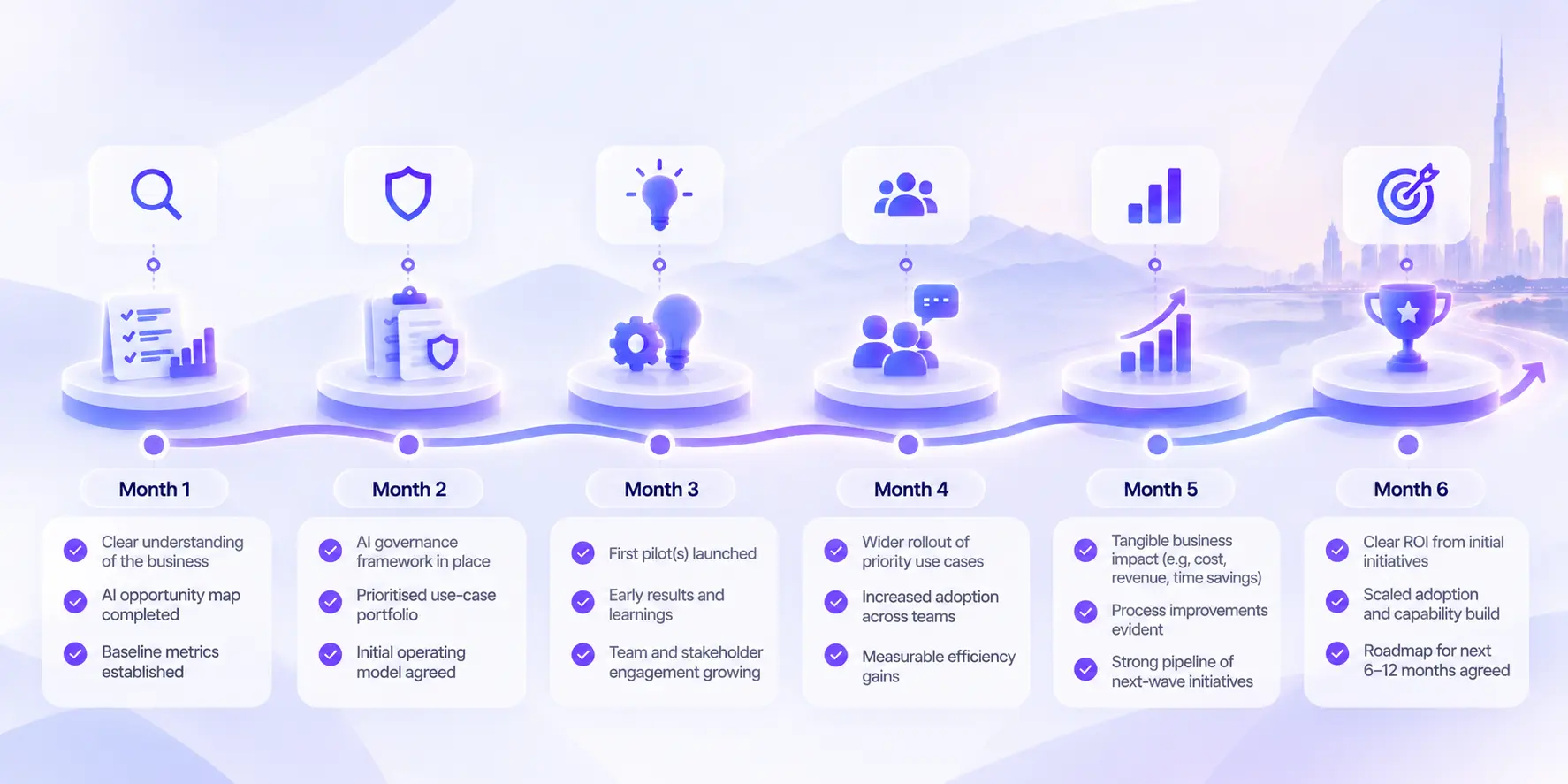 Milestones that show a fractional Chief AI Officer is working, from agreed priorities to measured business results
Warning signs are just as useful:
- Lots of meetings, workshops and slides, but no recorded decisions.
- Pilots that are "nearly there" for months.
- Goalposts that move whenever a result disappoints.
- Your team knows no more about AI than when it started.
- The CAIO is the only person who understands what's been built.
How do you choose a good fractional Chief AI Officer?
Judge them on how they'd run the role, not on how impressive their AI knowledge sounds. Questions worth asking:
- What will we own at the end? Listen for concrete deliverables and a handover plan.
- What will the first three months look like? A good answer is specific and starts with understanding your business, not recommending tools.
- How will you measure success, and when will we see the first result?
- Have you stopped a pilot? Why? Someone who has never stopped one probably isn't measuring properly.
- How do you handle governance and data rules in our sector and location?
- Are you tied to any software vendor? Independence matters when they're choosing tools on your behalf.
- How many clients do you serve at once, and how much of your time will we really get?
- Who on our side do you need, and how much of their time?
- How does this end? The right answer is that it ends when your team can run AI without them.
Check their track record by talking to past clients, not just reading case studies.
Is a Chief AI Officer required in the UAE?
For some organisations, effectively yes. For most private companies, not by law, but increasingly in practice.
In April 2024 Dubai launched the <a href="https://www.agbi.com/ai/2024/04/dubai-to-appoint-ai-officers-across-all-government-entities" target="_blank" rel="nofollow noopener noreferrer">Dubai Universal Blueprint for Artificial Intelligence</a>, which requires every Dubai government entity to appoint a Chief AI Officer. In September 2024 the UAE federal government <a href="https://mediaoffice.ae/en/news/2024/september/05-09/mohammed-bin-rashid-meets-ai-ceo-in-federal-government" target="_blank" rel="nofollow noopener noreferrer">introduced a dedicated AI leadership role</a> for ministries and federal entities. Companies that work with government, supply it or want to take part in its AI programmes are increasingly expected to show the same kind of AI ownership.
There are also specific rules in the financial free zones. In the DIFC, <a href="https://www.clydeco.com/en/insights/2023/09/difc-enacts-landmark-regulation-autonomous-systems" target="_blank" rel="nofollow noopener noreferrer">Regulation 10 of the DIFC Data Protection Regulations</a>, in force since September 2023, covers personal data processed through autonomous and semi-autonomous systems, which includes most AI tools. It requires clear notices to users and a register of systems, and for high-risk processing it requires, among other conditions, the appointment of an Autonomous Systems Officer, a role similar to a Data Protection Officer. ADGM runs its own data protection regulations alongside UAE federal law.
None of this means every UAE business must appoint a CAIO. It does mean someone senior needs to understand which rules apply and own compliance. That's a large part of what a fractional CAIO does here, usually alongside your legal and compliance teams rather than instead of them. We cover the governance side in more detail on our AI governance page.
How does CAPIO PRO approach the fractional CAIO role?
We run the fractional Chief AI Officer role as the leadership layer of a wider AI operating system, not as a standalone advisory seat. Here's how it works and why.
We start with a baseline. Most engagements begin with an AI readiness assessment that scores the organisation across seven pillars: leadership, governance, data, technology, capability, measurement and trust. Why: you can't prioritise, or prove progress later, without knowing where you started.
We build governance in the second month, not the last. A monthly AI committee with real decision rights, responsible AI guardrails written for UAE rules and a named owner and metric for every initiative. Why: governance done late is what stops working pilots from ever reaching production.
Every initiative has to earn its place. Use cases are scored on value and feasibility. The strongest go through AI pilots with clear gates, and ones that don't prove value are stopped early. Why: a short portfolio of measured wins beats a long list of experiments.
We build fluency on your live work. Through AI leadership training for boards, leaders and teams, built on your own initiatives rather than generic examples. Why: adoption depends on people understanding what's being built and why.
We plan our own exit. The mandate includes building the internal capability and operating model so your team can run the function. Why: a fractional CAIO who leaves you dependent has failed, however good the work looked.
If you're not ready for ongoing leadership, the readiness assessment works on its own, and you can decide on fractional leadership once your priorities are clear. Our pricing page explains how we scope engagements.
Frequently asked questions
What is the difference between a fractional CAIO and an AI consultant?
A consultant advises on a defined project and leaves. A fractional CAIO holds the leadership role on an ongoing basis and is accountable for results over months.
What is the difference between a CAIO and a CTO?
A CTO owns the technology platform and engineering. A CAIO owns how AI creates business value, how it's governed and whether it's working. In smaller organisations the two work closely together, but they answer different questions.
How many hours does a fractional Chief AI Officer work?
It varies by provider and stage. Published offers in October 2026 ranged from about 15 to 35 hours a month, typically heavier at the start.
How long does a fractional CAIO engagement last?
Most run for at least several months, because governance and measured results take time. Six to twelve months is common. A good engagement is designed to end once your team can run AI itself, or once you're ready for a full-time hire.
Is a fractional CAIO only for small companies?
No. Mid-sized and larger organisations use the model too, especially when they need senior AI leadership quickly, want to prove value before creating a permanent role or can't yet judge full-time candidates.
Can a fractional CAIO help us hire a full-time Chief AI Officer later?
Yes, and that's one of the better reasons to start fractional. By the time you hire, the role, the roadmap and the business case are proven, and you know what good looks like.
Which industries benefit most?
Any organisation with real AI activity and no clear owner. Regulated sectors such as financial services and healthcare often benefit most, because governance and data rules make ownership essential.
Where to start
If you're unsure whether you need a fractional CAIO, start by finding out where you stand. Our free AI readiness check gives you a score in a few minutes, or you can talk to us about what you're seeing in your own organisation.