
11 min read · AI leadership · AI strategy
What does a fractional Chief AI Officer do?
Capio team

Short answer: they own direction, governance, vendor choices and delivery of real outcomes. See the first ninety days, monthly deliverables, engagement models and success metrics.
A fractional Chief AI Officer is a part time executive who owns direction, governance, vendor decisions and delivery for AI across the business. They turn scattered pilots into a measured portfolio that ships working systems and reports real outcomes.
They sit with the leadership team, set guardrails, pick build versus buy, and make trade offs that stick. Their job is to create value and leave a capable team, not sell endless advisory hours.
What is a fractional Chief AI Officer?
A fractional Chief AI Officer is an executive leader engaged part time to set AI strategy, governance and delivery, with organisational authority not just advisory time. They often chair or drive an AI governance forum, own the roadmap and vendor landscape, and report to the CEO or COO. Adoption of the role is rising and companies with a CAIO report higher AI returns, according to IBM Think’s 2026 view of the market which cites 76 percent adoption and a 5 percent uplift in AI ROI for firms with a CAIO in place (IBM Think).
What does a fractional Chief AI Officer own day to day?
They own four things that determine whether AI creates value or noise.
- Direction and roadmap
- Run or commission a readiness baseline and set a ranked roadmap by value and risk. Keep a live value map and portfolio view. This mirrors market guidance that puts direction first, anchored in an assessment and an executable plan (NevTech AI).
- Vendor judgement and architecture calls
- Shortlist and select models and platforms. Decide build versus buy and the integrations that make them safe and supportable. Keep vendor claims honest with trials and reference checks.
- Governance and policy that enables speed
- Establish a committee charter, responsible AI guardrails, human in the loop rules, impact assessments where required, and an AI inventory and risk register, with board level reporting.
- Delivery oversight and outcomes
- Move candidates through evidence gates, unblock decisions and measure in numbers. Report adoption, cycle time, savings or uplifts and risk status monthly, not anecdotes.
Outputs a board should see monthly
- A one page portfolio dashboard with targets and actuals
- A decisions log that shows trade offs made and by whom
- Updated risk register with mitigations and owners
- Changes to guardrails where experience demands it
- A short lessons learned note from the month’s releases
When do you actually need a fractional Chief AI Officer and when do you not?
You likely need one when
- You have multiple tools in use with no policy or governance and leadership debate is not turning into decisions (Fractionus)
- Pilots have stalled or failed and the board wants a strategy with numbers and accountability (Fractionus)
- You must choose platforms or vendors now and do not have senior bandwidth to own the calls (NevTech AI)
You likely do not need one when
- You only want a quick chatbot demo or single use case. Hire a consultant or a delivery team for that (NevTech AI)
- You already have a CAIO or a CTO and CDO pair with clear AI ownership and time to lead the programme
- AI is not in the top five priorities for the next two quarters
How does the first ninety days run in practice?
A workable ninety day plan is visible week by week and ships something real. One pattern published in the market runs discovery, build, adopt and optimise within the first quarter with weekly and monthly cadences (Meet Caddy first ninety days).
A practical ninety day checklist
| Phase | Output by end | Red flags to watch |
|---|---|---|
| Baseline and decide | Readiness baseline, ranked roadmap with value estimates, committee charter drafted | Only a slide deck of ideas, no numbers or owners |
| Build and prove | One or two proofs of concept in client accounts, initial guardrails live | Nothing shipped by the mid point, work runs in vendor or agency accounts (Meet Caddy) |
| Adopt and measure | First workflow in production, early adoption metrics, risk register with actions | No dollar or hour figure attached to value, no team involvement (Meet Caddy) |
| Optimise and plan | Lessons learned, next wave agreed, handover plan in outline | A roadmap instead of shipped work and decisions (Meet Caddy) |
Cadence matters. Expect weekly check ins and a short monthly written summary as a default rhythm (Meet Caddy first ninety days).
How is a fractional Chief AI Officer different from a CTO, CDO or consultant?
- Fractional CAIO: owns AI product roadmap, vendor calls, governance and delivery outcomes across functions. Reports to the CEO or COO and chairs an AI governance forum (Assembly).
- CTO: owns core technology platforms, security, reliability and infrastructure. Partners with the CAIO to make AI safe and supportable.
- CDO: owns data strategy, quality and analytics. Partners on model access, data contracts and measurement.
- Consultant or agency: can advise or build, but does not hold executive decision rights. Be wary of builds that live in the vendor or agency’s accounts rather than yours (Meet Caddy).
How does a fractional Chief AI Officer plug into an AI operating system?
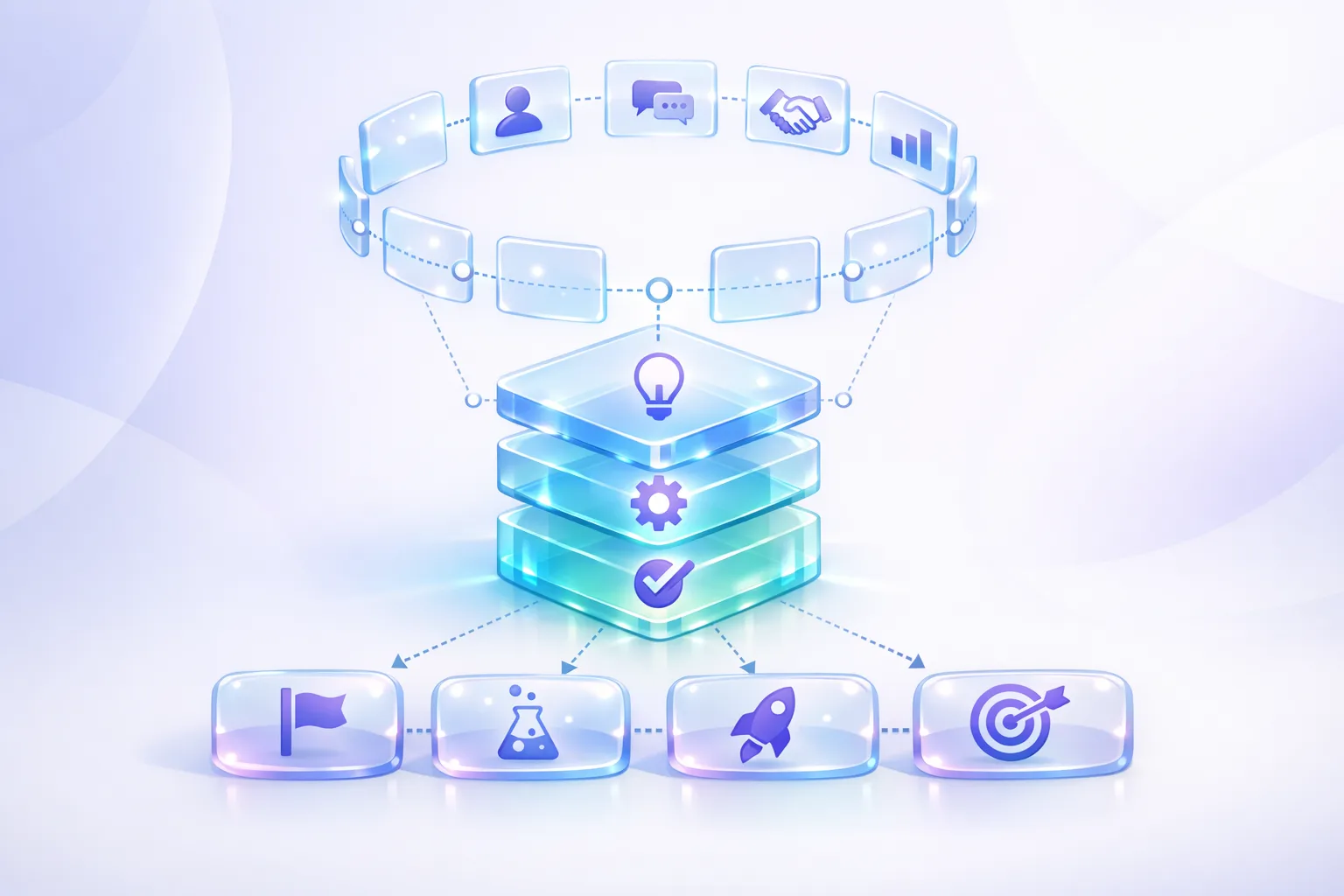
Strong programmes run as an operating system over six to twelve months, with four phases and a monthly steering committee with real decision rights. Delivery flows through gates so evidence decides the next spend.
- Phases: foundation, capability, execution, then scale and handover
- Steering committee: monthly, holds decision rights on priorities, risks and investment
- Delivery gates: proof of concept in roughly two to six weeks, minimum viable product in roughly one to three months, then an enterprise solution owned by your team
This gives the fractional CAIO a clear tempo to drive decisions and protect standards while value ships.
What deliverables and guardrails should you expect each month?
Expect a short, concrete pack that lets the board and executives judge progress and risk.
- Portfolio dashboard with targets versus actuals on value, adoption and cycle time
- Committee decisions log and open escalations
- AI inventory and risk register updated, with mitigations and owners
- Responsible AI guardrails and human in the loop rules, tightened where needed
- Impact assessments where required by policy or regulation
- A one page lesson learned from each release and what changed in the playbook
If you do not see these by the second or third month, ask why. If the work runs in outside accounts or cannot be handed to your team, stop and correct it (Meet Caddy).
What does it cost and how do engagement models work?
Models vary by scope, mandate and pace.
- Retained tiers published in the market: one provider lists an advisor tier at 2 hours per month at 495 dollars, a fractional officer tier at 8 hours per month at 1,800 dollars, and an embedded officer tier at 20 hours per month at 3,500 dollars, month to month after a ninety day runway (NevTech AI).
- Time cadence: some providers describe two to three days per week for hands on leadership, while others cite two to four days per month in early phases as the programme forms (Assembly; Fractionus).
- Full time alternative: a US salary guide places CAIO base pay typically between 280,000 and 650,000 dollars, higher at large firms (KORE1 salary guide).
- Agency comparison: one vendor claims agency retainers commonly run 50,000 to 120,000 dollars a year and warns that work often lives in agency accounts, which creates dependency. That claim is not externally sourced, so verify in your market (Meet Caddy).
Cost drivers to weigh
- Mandate breadth: governance only, or portfolio build and change across functions
- Delivery pace: number of pilots in flight and speed to production
- Vendor choices: hosted services versus private deployment and integrations
- Team capacity: how much capability must be built or hired

How do you evaluate candidates and avoid conflicts?
- Production first: prioritise leaders who have shipped AI to production and can show the governance assets that made it safe, not only slideware credentials (Assembly).
- References with setbacks: ask for references from engagements that hit problems and how they were handled (Assembly).
- Vendor agnostic stance: insist builds happen in your accounts and your team can run them. Avoid lock in to a consultant’s stack (Meet Caddy).
- Clear reporting line and mandate: to the CEO or COO with decision rights that match the job (Assembly).
How do you measure success?
Judge the role by outcomes and assets, not activity.
- Production deployments and adoption: number of workflows in production and usage by role
- Financials: savings, uplift or error reduction realised versus the plan
- Cycle time: time from idea to proof, and proof to production
- Risk controls: issues raised, mitigated and closed; audit findings addressed
- Capability transfer: internal team able to own systems and decisions without the fractional leader
- Portfolio balance: mix of quick wins and foundational bets, with clear learning
It helps that the market sees value when the role exists. IBM Think reports firms with a CAIO in place show a 5 percent uplift in AI ROI relative to peers (IBM Think).
How does CAPIO PRO approach the fractional Chief AI Officer role?
We run the fractional Chief AI Officer as the leadership layer of an embedded operating system so value compounds and the exit is planned.
- Establish the baseline
- What we do: run an AI readiness assessment across seven pillars, build a live baseline and produce an AI Health Score in three to four weeks.
- Why: decisions and value cases need a shared starting point the board accepts.
- Put guardrails in place
- What we do: set up a governance committee with a charter, responsible AI guardrails, human in the loop rules, impact assessments where required, and an inventory and risk register.
- Why: speed comes from clear rules and known decisions, not from skipping them.
- Move through delivery gates
- What we do: run proofs of concept in roughly two to six weeks, move to minimum viable products in roughly one to three months, then land enterprise solutions owned by your team.
- Why: evidence at each gate earns trust and avoids costly rework.
- Run a monthly steering committee
- What we do: hold a monthly forum with real decision rights, report the portfolio, risks and lessons, and unblock issues fast.
- Why: value compounding needs disciplined cadence and clear owners.
- Build capability and hand over
- What we do: coach your leaders and teams, document the operating manual and plan the exit from the start.
- Why: the engagement is designed for handover, not dependency.
Frequently asked questions
How much time each week does the role usually take?
It varies with scope and pace. Some programmes run two to three days per week for hands on leadership, while others start with two to four days per month in the early phase and increase as delivery ramps (Assembly; Fractionus).
Who should the role report to?
Usually the CEO or COO. The role should have authority to set the roadmap, chair the governance forum and make vendor and delivery decisions that stick (Assembly).
When should you switch to a full time hire?
Switch when the AI portfolio is large and persistent enough that leadership attention is needed most days, or when the remit spans core technology and data platforms alongside AI product. A long search can take months, so the fractional leader can bridge and hand over.
How do handover and knowledge transfer work?
Build in your accounts, create an operating manual and keep a decisions log. Handover then becomes a defined set of systems and practices, not a personality. Beware models where the work lives in a vendor or agency account (Meet Caddy).
How many pilots should run in parallel?
Enough to learn and de risk without overloading the team. A gated approach helps: keep a small number in proof of concept, move the best to minimum viable product, then scale. Capacity and evidence should govern the count.
Who should own the systems and accounts?
You should. Builds should happen in your cloud, with your credentials and monitoring. That is how you avoid lock in and enable handover (Meet Caddy).
Where to start
Start with a readiness baseline and an initial portfolio plan you can measure. If you want that run by a practitioner who builds for handover, talk to us.