
21 min read · AI Governance · AI Strategy
AI Governance: A Practical Framework for Businesses
Capio team

A practical AI governance framework for businesses: what it is, who owns it, the policies, inventory and risk tiers you need, the rules to know and how to start in weeks.
AI governance is the set of decisions, rules and checks that control how an organisation uses AI. It answers four plain questions. Which AI are we using? Who is allowed to approve it? What could go wrong? How do we know it's working? If you can answer those for every AI system in the business, you have AI governance. If you can't, you have AI activity.
Most guides to AI governance are written either by regulators, who explain principles, or by software vendors, who explain why you need their platform. Both have their place. This guide is for the people in between: leaders who need a working framework they can set up in weeks, that keeps the business safe without slowing every project down.
What is AI governance?
AI governance is how an organisation directs and controls its use of artificial intelligence. It covers who owns AI decisions, which uses are allowed, how risks are assessed, how data is handled, where people stay in control and how results are monitored over time.
It helps to separate it from a few neighbouring ideas:
- AI ethics sets out the values: fairness, transparency, respect for people. Governance is how those values get turned into decisions and checks.
- AI compliance is meeting legal requirements. Governance includes compliance, but also covers risks the law doesn't, such as reputational damage or a bad business decision built on a confident but wrong AI answer.
- Data governance controls data quality, ownership and access. AI governance depends on it, because an AI system is only as safe as the data it can reach.
- AI security protects AI systems from attack and misuse. It's one important part of governance, not the whole of it.
The most useful way to think about it: AI governance is a management discipline, not a technical one. Technology teams play a big part, but the questions it answers are business questions about responsibility, risk and value.
Why does AI governance matter for businesses?
Because AI is now spreading through organisations faster than anyone is tracking it, and the decisions it influences still belong to you.
A few things have changed at once:
- AI arrives without a project. Staff sign up for chatbots on their own. AI features appear in your CRM, email and office software through ordinary updates. Nobody approved them, and nobody has checked what data they can see.
- AI now makes or shapes decisions. Screening CVs, scoring leads, drafting customer replies, summarising contracts, flagging fraud. When those outputs are wrong or biased, the organisation carries the responsibility, not the tool.
- Regulation has arrived. The EU AI Act is in force, data protection law applies to AI just as it does to anything else and sector regulators are asking questions.
- Trust is a commercial issue. Customers, partners and investors increasingly ask how you use AI and how you control it.
Leaders feel this already. According to research by the IBM Institute for Business Value <a href="https://www.ibm.com/think/topics/ai-governance" target="_blank" rel="nofollow noopener noreferrer">cited by IBM</a>, 80% of business leaders see explainability, ethics, bias or trust as a major roadblock to generative AI adoption.
The less obvious point is that good governance speeds AI up. When teams know which tools are approved, what data they can use and who signs off, they stop waiting for case-by-case permission. Projects that would have stalled at a legal or security review at the end get the right answers at the start. Without governance, the usual pattern is the opposite: a burst of pilots, then a freeze when someone senior realises nobody knows what's running.
What principles should AI governance be built on?
Most frameworks, from international bodies to standards organisations, rest on a similar set of principles. In practical terms:
- Accountability. A named person is responsible for every AI system and its outcomes. "The algorithm decided" is never an acceptable answer.
- Transparency. You can explain what an AI system does, what data it uses and how it reaches its outputs, at a level suited to the people affected.
- Fairness. You check that systems don't treat people or groups unfairly, especially where they affect jobs, money, health or access to services.
- Privacy and security. Data is used lawfully, only for its purpose and is protected from leaks and misuse.
- Human oversight. People stay in control of decisions that matter, with the ability to review, override and stop AI systems.
- Proportionality. Controls match the risk. A tool that drafts internal meeting notes doesn't need the same scrutiny as one that decides who gets a loan.
That last principle is the one most organisations get wrong. Treat everything as high risk and governance becomes a brake. Treat nothing as high risk and it becomes decoration.
What does a practical AI governance framework include?
A working framework has seven building blocks. You don't need all of them at full strength on day one, but you need a basic version of each.
| Building block | The question it answers | Minimum version | Mature version |
|---|---|---|---|
| Ownership and decision rights | Who decides? | A senior sponsor and a small group that approves AI use | A steering committee with a charter, clear decision rights and board reporting |
| AI inventory | What AI are we using? | A spreadsheet of tools, owners, purposes and data | A live register covering every system, vendor, integration and change |
| Risk classification | How risky is each use? | Three tiers: low, medium, high | Tiers mapped to regulation, with criteria and required controls for each |
| Policies and guardrails | What's allowed? | A short acceptable use policy and a list of approved tools | Policies by use type, data rules, vendor standards and exception routes |
| Lifecycle controls | How do we check before and after launch? | An intake form and a sign-off for medium and high risk uses | Impact assessments, testing, human review rules, access limits and change control |
| Monitoring and measurement | Is it still working and safe? | Named owners who review each system periodically | Defined metrics, incident logging, regular reassessment and audit trails |
| People and AI literacy | Do people know how to use AI well? | Basic training on the policy and safe use | Role-based training, shared language and leaders who can challenge AI decisions |
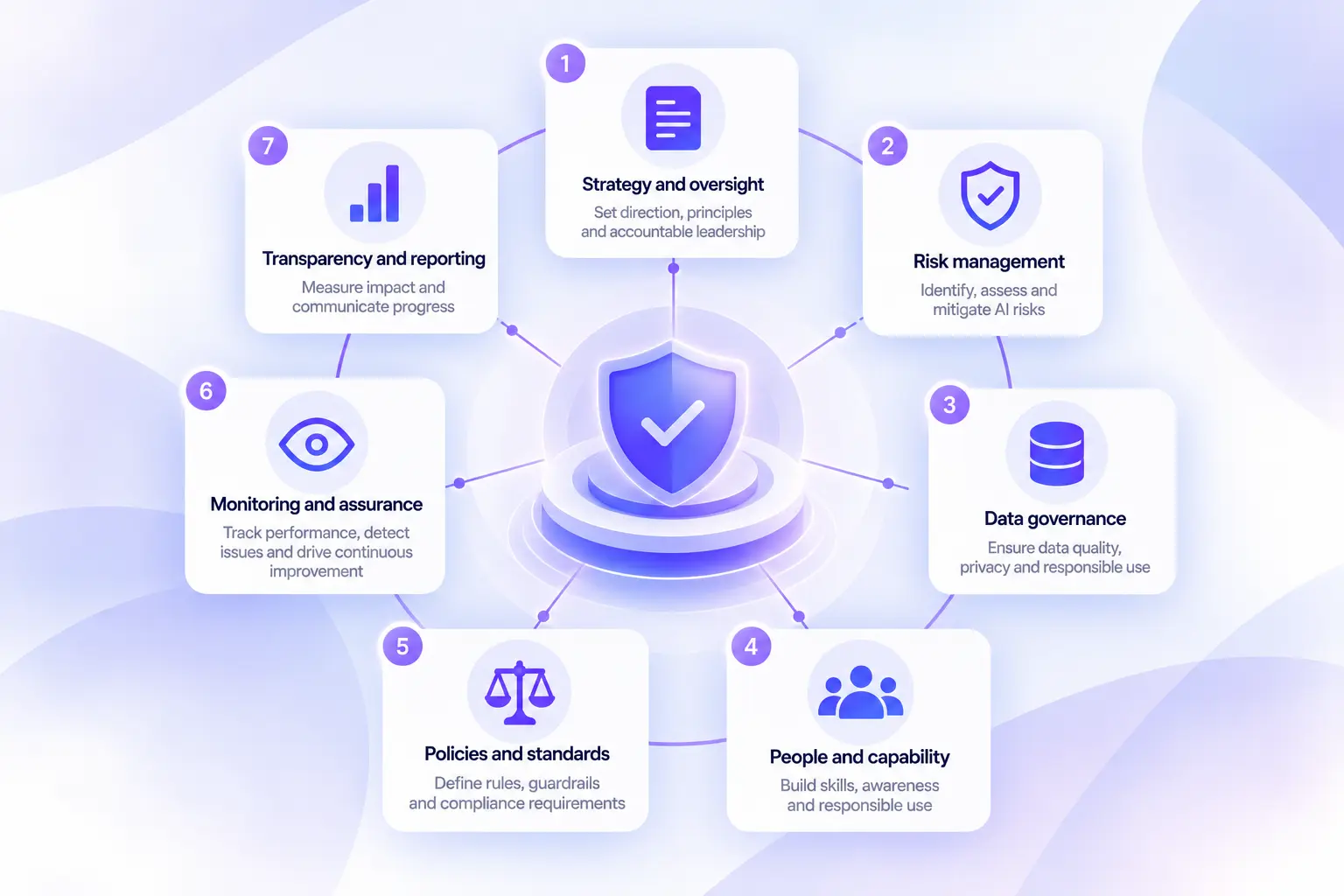 Seven building blocks of an AI governance framework: ownership, inventory, risk classification, policies, lifecycle controls, monitoring and AI literacy
Ownership and decision rights
Governance fails fastest when everyone is involved and nobody decides. Start by naming a senior sponsor, usually the CEO, COO or another executive with authority across departments. Then set up a small AI steering group of four to six people who meet regularly and make decisions: which uses are approved, which are stopped, what gets funded and what risks are accepted.
Write down what the group can decide and what must go to the board. Record the decisions. That record becomes your evidence when a regulator, auditor or customer asks how you control AI.
AI inventory
You can't govern what you can't see. The inventory, sometimes called an AI register, lists every AI system in use, including ones nobody formally approved.
Look in three places: tools staff use on their own, AI features built into software you already pay for and AI systems your organisation builds or commissions. The second group is the easiest to miss. AI features often switch on through routine updates, and they frequently connect to systems holding customer and business data.
Risk classification
Not every AI use deserves the same attention. A simple three-tier model works for most businesses and maps reasonably well onto how regulation thinks about risk.
| Tier | Typical examples | What it needs |
|---|---|---|
| Low | Drafting internal documents, summarising meeting notes, brainstorming, code suggestions reviewed by developers | Approved tool, acceptable use policy, no restricted data |
| Medium | Customer-facing chatbots, marketing content at scale, AI connected to CRM or internal knowledge, sales lead scoring | Named owner, review before launch, clear disclosure to users, human escalation route, periodic checks |
| High | Decisions about hiring, credit, insurance, health, pricing for individuals, access to services, or anything safety-critical | Formal impact assessment, testing for accuracy and bias, human approval of decisions, logging, legal review, regular reassessment |
Some uses shouldn't be allowed at all, such as manipulating people or the specific practices banned under the EU AI Act. Name these explicitly in your policy.
Reassess the tier when things change. A tool that starts as low risk can become medium or high risk when someone connects it to customer data or starts using its output for decisions.
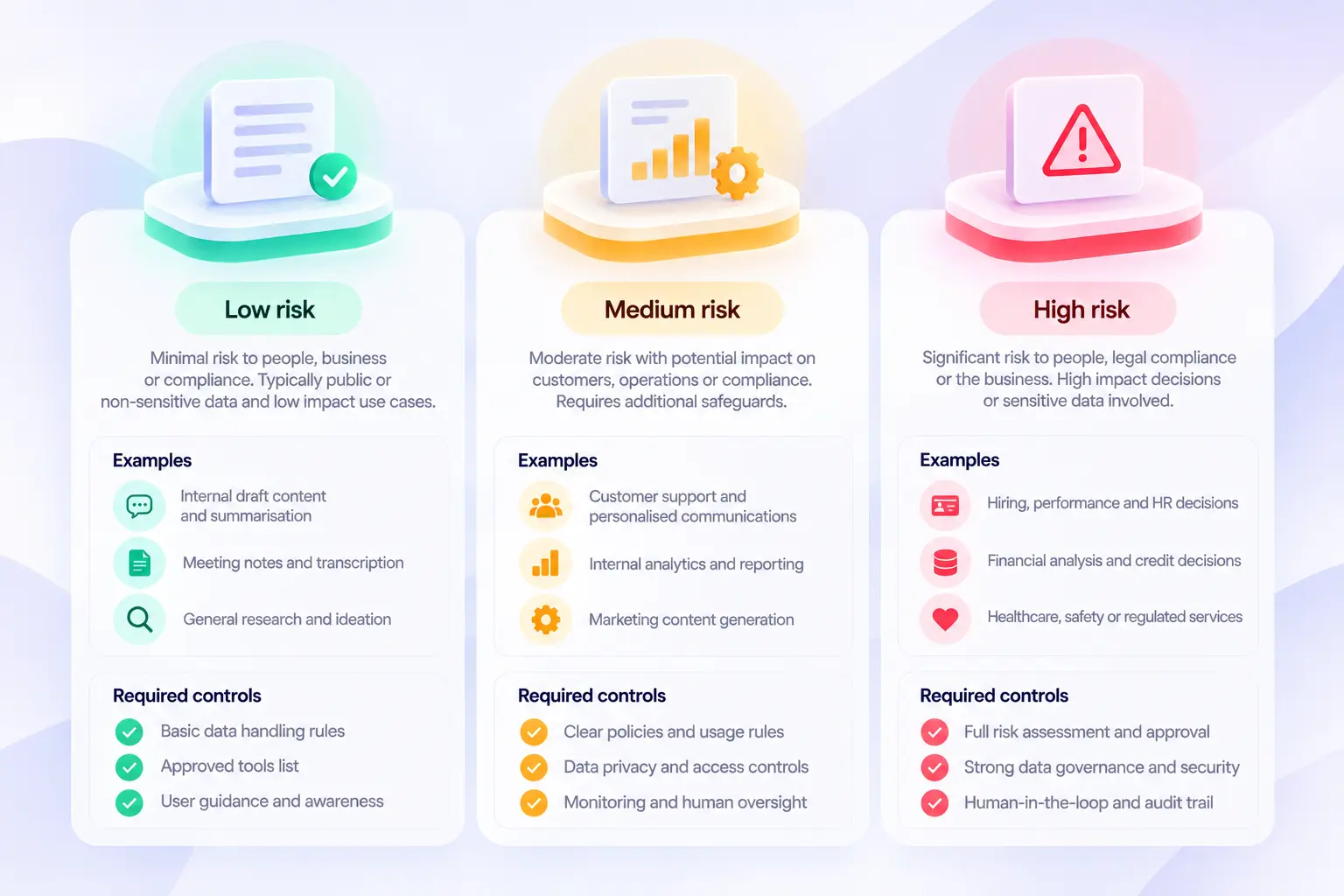 AI risk classification tiers showing low, medium and high risk uses with the controls each requires
Policies and guardrails
Keep the first policy short enough that people will actually read it. Two or three pages beats thirty. The aim is to tell staff clearly what they can do, what they can't do and who to ask.
Lifecycle controls
Controls are where policy becomes practice. The core set: an intake step so new AI uses are registered and tiered before they start, a review proportionate to the tier, rules about where a human must approve or check outputs, access limited to the data and systems a use actually needs, vendor checks and a process for handling changes and incidents.
Monitoring and measurement
AI systems change after launch. Models get updated, data shifts, usage spreads into areas nobody planned for. Every system needs an owner who checks periodically that it still does what it was approved to do, that output quality hasn't slipped and that the controls still fit.
People and AI literacy
Governance only works if people understand it. Staff need to know the rules and why they exist. Leaders need enough understanding to ask good questions and challenge AI-driven proposals. The EU AI Act now includes an explicit AI literacy obligation for organisations that provide or use AI systems, which has applied since February 2025.
How do you implement AI governance step by step?
You can have a working foundation in about three months without a large programme. Here's a realistic sequence.
Weeks one to two: get visibility. Name the sponsor. Survey teams about the AI tools they use. Check your main software platforms for AI features that are switched on. Build the first version of the inventory, even if it's rough.
Weeks three to four: set the basics. Form the steering group and agree its decision rights. Agree the three risk tiers. Write a short acceptable use policy and a list of approved tools. Communicate both to all staff.
Weeks five to eight: classify and control. Tier everything in the inventory. Assign an owner to every medium and high risk use. Put the intake and review process in place for new requests. Fix the obvious gaps, such as tools with access to data they don't need or customer-facing AI with no escalation route.
Weeks nine to twelve: embed and measure. Run AI literacy sessions, starting with leaders and the teams using AI most. Hold the first full steering group review. Agree the handful of metrics you'll report. Report to the board for the first time.
After that, governance becomes a rhythm: monthly steering decisions, quarterly reassessment of higher-risk systems and an annual review of the framework itself.
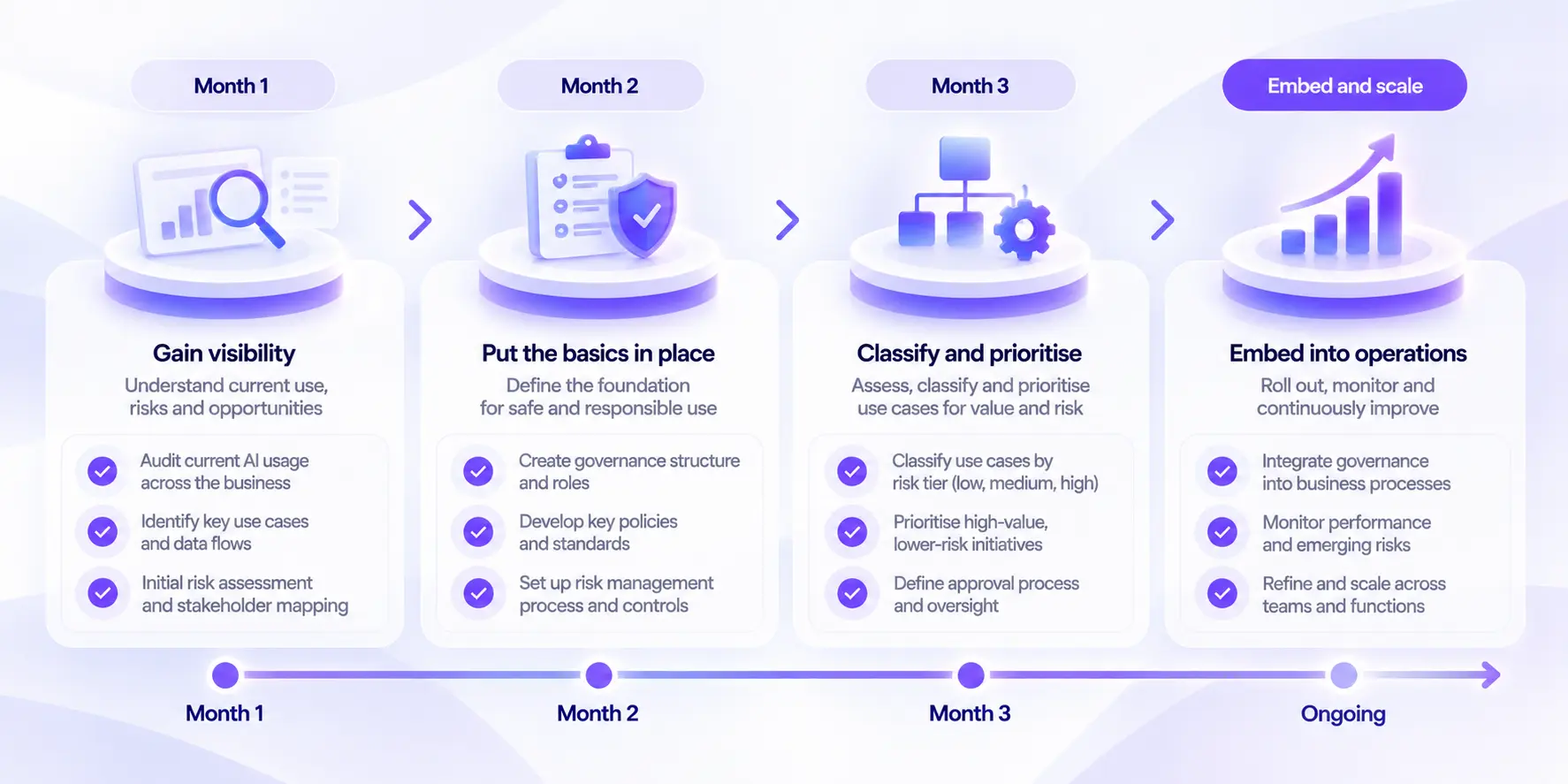 Three-month AI governance implementation timeline: visibility, basics, classification and embedding
What should an AI policy include?
A practical first AI policy covers:
- Purpose and scope. Why the policy exists and who it applies to, including contractors.
- Approved tools. Which AI tools are allowed, and the process for requesting new ones.
- Data rules. What must never be entered into AI tools, such as personal data, client confidential information, credentials or unreleased financial results, unless the tool is approved for it.
- Prohibited uses. Uses the organisation won't allow under any circumstances.
- Human review. Where AI outputs must be checked by a person before they're used or sent.
- Disclosure. When customers or others must be told they're dealing with AI or AI-generated content.
- Accountability. That the person using AI remains responsible for the result.
- Reporting. How to report problems, mistakes or suspected misuse.
- Review. How often the policy is updated.
What should an AI inventory record?
| Field | Why it matters |
|---|---|
| System name and vendor | Know exactly what you're using and who supplies it |
| Business owner | Someone accountable for its use and outcomes |
| Purpose and users | What it's for and who uses it |
| Data it can access | The biggest driver of risk |
| Integrations | Which other systems it connects to |
| Risk tier | Determines the controls it needs |
| Human oversight | Where people review or approve outputs |
| Whether it affects decisions about people | Flags higher-risk uses quickly |
| Data used for vendor model training | A common and avoidable data leak |
| Approval date and next review | Keeps the register current |
Who should own AI governance?
Ultimately the leadership team and board, with day-to-day responsibility spread across a few clear roles. Governance rarely works when it sits only with IT or only with legal.
| Role | Responsibility |
|---|---|
| Board | Sets risk appetite, receives regular reporting, holds leadership accountable |
| Executive sponsor | Owns AI governance overall, clears blockers, chairs or backs the steering group |
| AI steering group | Approves uses, sets priorities, accepts or rejects risks, records decisions |
| AI lead or Chief AI Officer | Runs the framework day to day, maintains the inventory and reports progress |
| Business owners | Accountable for each AI system in their area and its outcomes |
| Legal, compliance and data protection | Interpret regulation, run impact assessments, review contracts |
| IT and security | Control access, assess vendors, secure integrations, monitor technical risks |
| Internal audit | Checks independently that the framework is followed |
Smaller organisations can combine these. In a company of fifty people, the steering group might be the CEO, the operations lead, whoever handles IT and an external adviser, meeting once a month for an hour. What matters is that decisions are made, recorded and followed through.
Many mid-sized organisations don't have anyone senior who can run AI governance. That's one reason the fractional Chief AI Officer model has grown: part-time senior ownership while the organisation builds its own capability.
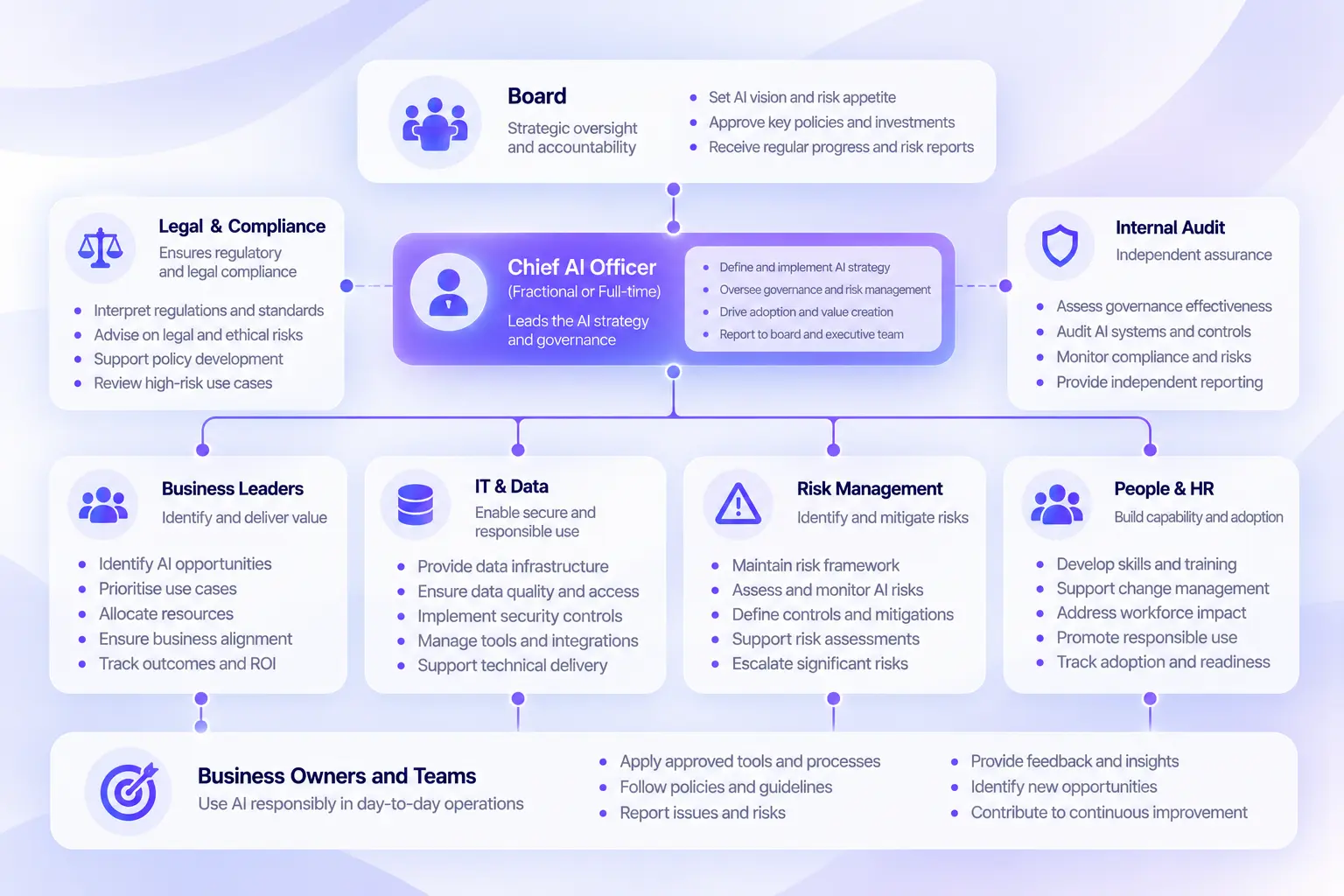 AI governance roles and responsibilities from board and executive sponsor to business owners, legal, IT and internal audit
Which regulations and standards should businesses know?
You don't need to become a legal expert, but you should know which frameworks apply to you and which ones are useful even if they're voluntary.
| Framework | Type | What to use it for |
|---|---|---|
| EU AI Act | Binding law in the EU, with reach beyond it | Risk-based obligations for anyone placing AI on the EU market or using it there |
| GDPR and other data protection laws | Binding law | Any AI that processes personal data |
| NIST AI Risk Management Framework | Voluntary US framework | A practical structure for managing AI risk, built around four functions: govern, map, measure and manage |
| ISO/IEC 42001 | International standard, certifiable | Setting up an AI management system, and proving it to customers through certification |
| OECD AI Principles | International principles | A shared reference for trustworthy AI used by many governments |
| Sector rules | Varies | Financial services, healthcare, insurance and employment often have their own expectations |
What does the EU AI Act require, and when?
The EU AI Act sorts AI into four categories: unacceptable risk (banned), high risk (strict obligations), transparency risk (disclosure duties) and minimal risk (no specific rules). According to the <a href="https://digital-strategy.ec.europa.eu/en/policies/regulatory-framework-ai" target="_blank" rel="nofollow noopener noreferrer">European Commission</a>, the key dates are:
- 1 August 2024: the Act entered into force.
- 2 February 2025: the first banned practices and the AI literacy obligation applied.
- 2 August 2025: obligations for general-purpose AI models applied.
- 2 August 2026: general application and enforcement began, including transparency rules such as telling people they're talking to a chatbot and labelling deepfakes.
- 2 December 2027: obligations for high-risk AI used in sensitive areas such as employment, education and credit.
- 2 August 2028: obligations for high-risk AI built into products covered by EU product safety law, such as medical devices and machinery.
The two high-risk dates were pushed back by the <a href="https://natlawreview.com/article/eu-digital-omnibus-ai-enters-force" target="_blank" rel="nofollow noopener noreferrer">AI Omnibus amendments</a>, which entered into force on 27 July 2026. The same amendments added a ban on systems that generate non-consensual intimate imagery or child sexual abuse material, applying from December 2026. Fines under the Act reach up to EUR 35 million or 7% of worldwide annual turnover for the most serious breaches.
Don't read the delay as permission to wait. Building an inventory, classifying risk and documenting decisions takes time, and the organisations that start now will have far less to do when the obligations land.
Should you get ISO/IEC 42001 certified?
ISO/IEC 42001, <a href="https://www.dqsglobal.com/en/explore/dqs-knowledge-center/iso-42001-explained" target="_blank" rel="nofollow noopener noreferrer">published in December 2023</a>, is the first international standard for AI management systems, and organisations can be independently certified against it. Certification makes most sense if customers or partners are asking for evidence of responsible AI, or if you sell AI products. For most businesses, it's a useful reference to build towards rather than a first step.
The <a href="https://www.nist.gov/itl/ai-risk-management-framework" target="_blank" rel="nofollow noopener noreferrer">NIST AI Risk Management Framework</a>, released in January 2023 with a generative AI profile added in July 2024, is free and voluntary. Its four functions (govern, map, measure and manage) are a good checklist even if you never cite it.
How mature is your AI governance?
A simple way to see where you stand:
| Level | What it looks like | Typical next step |
|---|---|---|
| Unmanaged | AI used freely, no inventory, no policy, nobody owns it | Name a sponsor and find out what's in use |
| Reactive | Rules written after something goes wrong; approvals depend on who you ask | Agree risk tiers and a single intake route |
| Defined | Policy, inventory, risk tiers and a steering group in place | Add monitoring, metrics and training |
| Embedded | Governance runs as a regular rhythm, decisions are recorded and the board sees live reporting | Continuous improvement, external assurance or certification |
If you're unmanaged or reactive, you're not unusual. The jump to defined is where most of the value is, and it doesn't take long.
A structured AI readiness assessment is one way to get an honest baseline, because governance gaps usually sit alongside gaps in data, leadership and measurement.
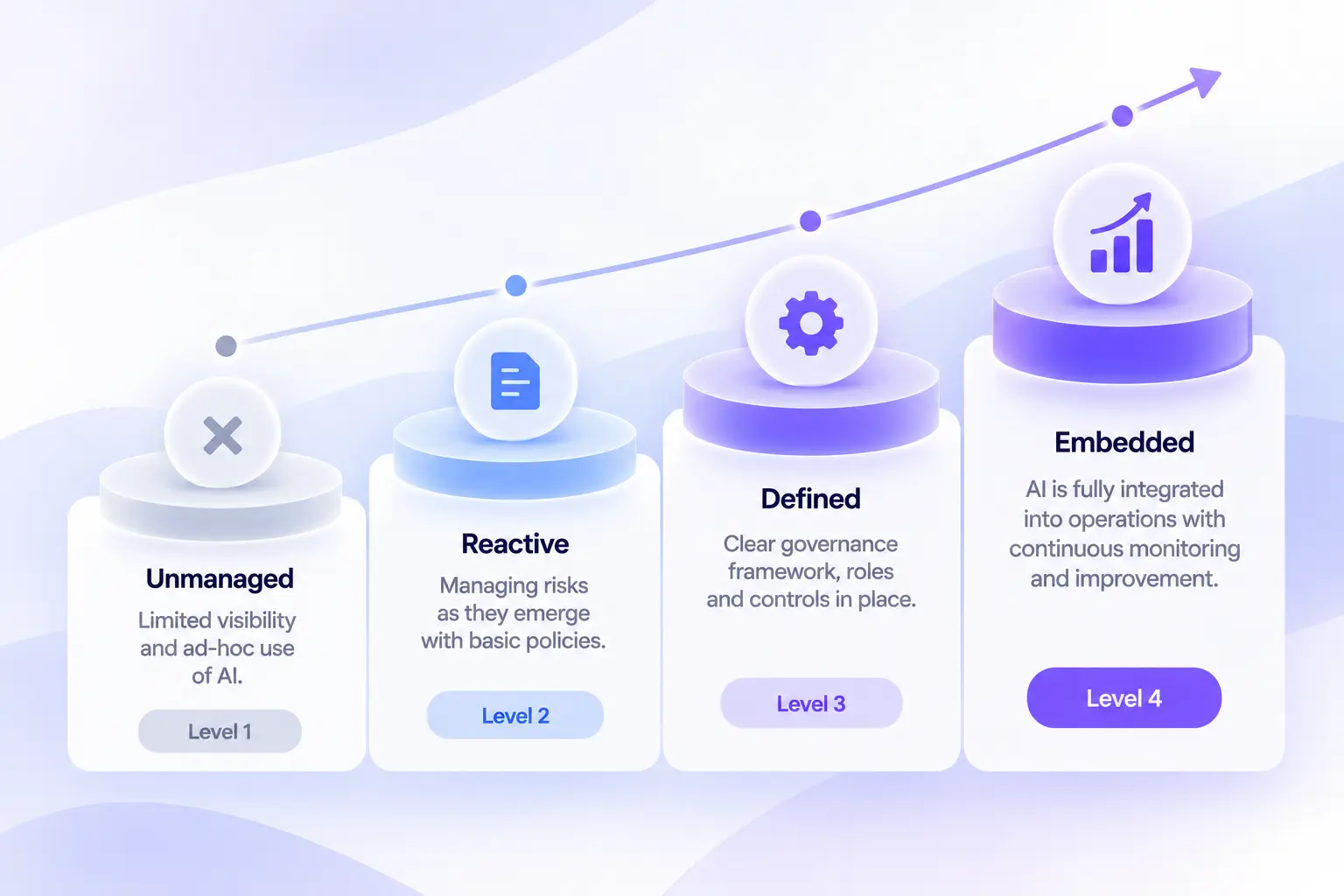 AI governance maturity levels from unmanaged and reactive to defined and embedded
How do you govern generative AI and AI agents?
Generative AI and agents need a few extra controls on top of the framework above.
Generative AI brings three specific risks. Data leakage, when staff paste confidential information into tools that may store it or use it for training. Confident errors, when outputs sound authoritative but are wrong. And intellectual property questions about what the model was trained on and who owns the output. The controls: approved enterprise versions of tools with training on your data switched off, clear rules on what can be entered, human review for anything external or decision-relevant and disclosure where required.
AI agents go further, because they take actions rather than just producing text. An agent that can send emails, update records, make purchases or call other systems needs:
- Least-privilege access. Only the systems and permissions the task requires.
- Clear limits. What it can do alone, what needs human approval and what it must never do.
- Logging. A record of every action it takes, so problems can be traced.
- A kill switch. A simple way to stop it.
- Testing in a safe environment before it touches live systems or customers.
The more an agent can do, the bigger the damage when it goes wrong. Start agents on low-risk, reversible tasks and expand their permissions only on evidence.
How do you measure whether AI governance is working?
Track a small set of measures and report them to the steering group and board:
- Coverage. The share of AI systems in the inventory with a named owner and a risk tier.
- Speed. How long it takes to approve a new AI use. If this keeps rising, governance is becoming a brake.
- Control. The share of medium and high risk systems with completed reviews and up-to-date reassessments.
- Incidents. Number and severity of AI-related problems, and how quickly they were resolved.
- Literacy. The share of staff and leaders who have completed AI training.
- Value. Whether governed AI initiatives are delivering the results they were approved for.
That last one matters. Governance exists to make AI deliver value safely. If you only measure risk, you'll build a framework that says no.
What are the most common AI governance mistakes?
- Writing a policy and stopping. A policy nobody follows and nobody checks is worse than none, because it creates false comfort.
- Treating everything as high risk. Teams route around governance that makes simple things slow.
- Leaving it to IT or legal alone. Business owners must be accountable for AI in their areas.
- Forgetting embedded AI. The AI inside software you already use is often the biggest blind spot.
- Governing only at launch. Systems change after approval. Without reassessment, the original review goes stale.
- No decision record. If decisions aren't written down, you can't prove control to anyone.
- Waiting for regulation. By the time obligations apply, the organisations that started early have a large head start.
How does CAPIO PRO approach AI governance?
We build AI governance into the foundation of an AI programme rather than adding it at the end. Here's how we work and why.
We start with a baseline. Governance is one of seven pillars we score in a readiness assessment, alongside leadership, data, technology, capability, measurement and trust. Why: governance problems rarely exist alone, and fixing them without the others doesn't stick.
We set up a committee that actually decides. A steering committee with real decision authority and a written charter. Why: approvals that depend on who you ask are what make teams avoid governance.
We put guardrails on every use case. Responsible AI guardrails, human-in-the-loop rules for decisions that carry weight and data protection impact assessments where the law expects them. Why: clear rules let teams move without asking permission case by case.
We keep an inventory and risk register. Every AI system, its owner and its risk, kept current. Why: you can't defend what you can't see.
We measure that controls are followed. Board reporting and a measurement process that shows governance is working in practice. Why: a framework nobody can evidence won't survive scrutiny.
We hand it over. Clients finish owning the framework and running it themselves. Why: governance that depends on an outside firm isn't really yours.
Governance usually sits inside a wider AI operating system, alongside an AI strategy and AI pilots that move through clear gates, with AI training for executives so leaders can own the decisions.
Frequently asked questions
What is the difference between AI governance and data governance?
Data governance controls the quality, ownership and access of data. AI governance controls how AI systems are chosen, used and monitored. They overlap heavily, because most AI risk comes from the data a system can reach, but AI governance also covers decisions, outputs and accountability that data governance doesn't.
Do small businesses need AI governance?
Yes, but a lighter version. A small business needs a named owner, a short policy, a list of approved tools and a rule about what data never goes into AI. That can be in place in a week. The full framework scales up as AI use grows.
What is an AI governance framework?
A structured set of roles, policies, processes and controls for managing AI across an organisation. A practical one covers ownership, an AI inventory, risk classification, policies, lifecycle controls, monitoring and AI literacy.
Who is responsible for AI governance?
The board and leadership team are ultimately accountable. Day to day, it's usually run by an AI lead or Chief AI Officer with a steering group, while business owners are accountable for AI systems in their areas.
Does the EU AI Act apply to companies outside the EU?
It can. The Act applies to organisations that place AI systems on the EU market or whose AI outputs are used in the EU, wherever they're based. If you have EU customers, users or operations, check how it applies to you with legal advice.
How long does it take to set up AI governance?
A working foundation (owner, policy, inventory, risk tiers and a steering group) typically takes around three months. Embedding it as a routine with monitoring and reporting takes longer, usually six to twelve months.
Does AI governance slow down innovation?
Badly designed governance does. Good governance speeds things up, because teams know what's allowed, who decides and what checks a project needs before it starts, instead of discovering problems at the end.
Where to start
If you do one thing this month, build the inventory. Find out which AI tools and features are in use, who owns them and what data they can reach. Almost every other governance decision depends on it.
If you'd like a structured view of where you stand, take our free AI readiness check, or talk to us about setting up governance that helps your teams move faster.